Lapopu Waterfall: The King of Sumba's Waterfalls
Sumba Island is home to dozens of waterfalls scattered across its jungle interior but none commands the same respect as Lapopu. Located in West Sumba within the Manupeu Tanah Daru National Park, Lapopu is the largest and most powerful waterfall on the island -- a thundering cascade that drops approximately 70 metres into a wide natural pool surrounded by dense tropical forest. The sound reaches you long before the falls come into view.
Getting to Lapopu requires effort. There is a hike involved, the path is not always easy and the conditions can be challenging. But every person who makes the journey arrives at the base of Lapopu with the same expression -- complete awe. This is one of those natural wonders that justifies every difficult step to reach it.
The Hike to Lapopu Waterfall
The trail to Lapopu begins from a small parking area accessible by vehicle. From there the hike follows a path through the national park forest to the base of the falls. The total distance is approximately 2 to 3 kilometres one way depending on your starting point.
Difficulty level: Moderate. The path involves some uneven terrain, tree roots and can be slippery when wet. The descent to the base of the waterfall is the most challenging section -- steep in places and requiring careful footing. Trekking sandals or sturdy closed-toe shoes are essential. The hike is manageable for anyone with reasonable fitness but is not suitable for very young children or anyone with significant mobility limitations.
The total walking time from the parking area to the base of the falls is approximately 30 to 45 minutes one way depending on your pace and the trail conditions. Allow 2 to 3 hours total for the full experience including swimming time at the base.
A local guide is strongly recommended for the Lapopu hike. The national park path is not always clearly marked and a guide will not only ensure you stay on the correct route but will also provide essential context about the forest ecosystem and local traditions connected to the falls.
What to Expect at the Base
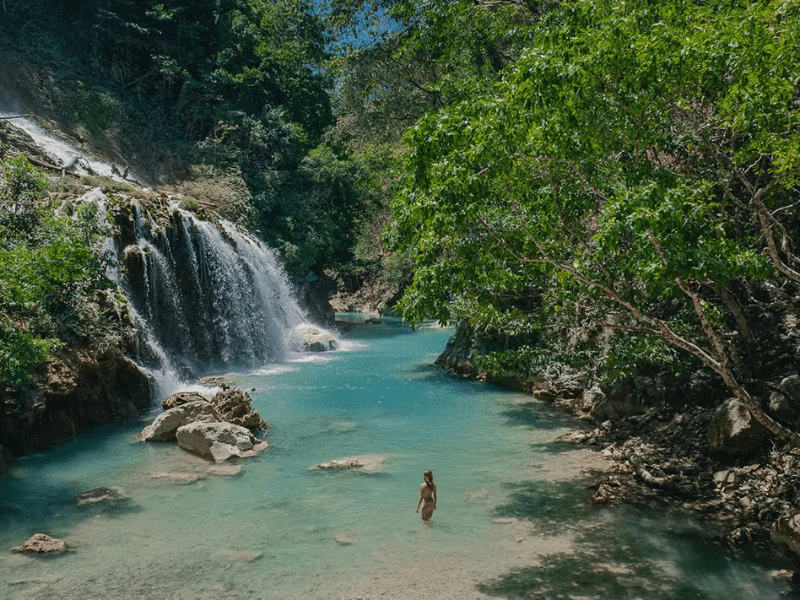
The reward for the hike is extraordinary. Lapopu's main drop sends a massive curtain of white water plunging into a large natural pool at its base. The spray from the falls creates a permanent mist that keeps the surrounding vegetation lush and the air cool -- a welcome relief from the Sumba heat. The pool is deep enough for swimming and the water is cool and refreshing.
The scale of Lapopu only becomes apparent when you are standing at its base. The cliff face behind the falls rises vertically, covered in ferns and mosses. The volume of water changes dramatically between the wet and dry seasons -- during the wet season from November to April the falls are at full power and the pool can become turbulent. During the dry season the flow reduces but the falls remain impressive and the swimming conditions are calmer and safer.
Manupeu Tanah Daru National Park
Lapopu sits within one of West Sumba's most important protected areas. The Manupeu Tanah Daru National Park covers over 87,000 hectares of tropical forest and is home to several endemic bird species including the Sumba hornbill, the citron-crested cockatoo and the Sumba green pigeon. The forest along the Lapopu trail is excellent bird watching territory and early morning visits offer the best chance of encountering the park's most spectacular avian residents.
The national park entrance requires a small fee which contributes to forest conservation and the maintenance of the trail infrastructure. This is one of the most biodiverse areas on Sumba and the protection of this ecosystem is genuinely important for the island's environmental future.
What to Bring for the Lapopu Hike
- Sturdy closed-toe shoes or trekking sandals -- the path can be slippery
- Swimwear -- the pool at the base is perfect for swimming
- Waterproof bag for phone and camera -- the spray from the falls is significant
- Plenty of water -- at least 1.5 litres per person
- Snacks for energy -- the hike and swim will work up an appetite
- Insect repellent -- the national park forest has mosquitoes
- Cash for the park entrance fee and guide payment
- A light rain jacket -- the forest microclimate can produce sudden showers
Best Time to Visit Lapopu
Lapopu is worth visiting in any season but each offers a different experience. The wet season from November to April delivers the most dramatic waterfall -- the full volume of water creates a thunderous display that can be felt as much as heard. However the trail can be muddy and slippery and swimming at the base may be unsafe due to turbulence.
The dry season from May to October offers the best hiking conditions and safest swimming. The waterfall is less powerful but still impressive and the surrounding forest is easier to navigate. Sunrise visits are recommended as the morning light filters through the forest canopy and the bird life is most active in the early hours.
Getting to Lapopu Waterfall
Lapopu Waterfall is located within Manupeu Tanah Daru National Park in West Sumba, approximately 35 kilometres from Waikabubak. The drive from Tambolaka Airport takes approximately 1.5 to 2 hours. The road to the national park entrance is mostly paved but the final approach can be rough. A vehicle with reasonable ground clearance is recommended particularly during the wet season.
Use Sumba Map to find Lapopu Waterfall and get accurate directions from your current location on the island. Many tourists attempt to navigate to Lapopu using Google Maps and find the location data unreliable in this part of West Sumba. Sumba Map's offline capability is particularly useful for this destination.
Combining Lapopu with Other West Sumba Attractions
Lapopu makes an excellent full morning activity that can be combined with an afternoon visit to Weekuri Lake or the traditional villages of Tarung and Praijing near Waikabubak. The waterfall is in the same general direction from Tambolaka as Waikabubak making it natural to combine with any West Sumba itinerary.
Practical Information